
I spent way too many years at university, so folks frequently ask me about choosing a major. My answer has evolved to our topic today, and its current form dovetails nicely into early retirement and especially semi-retirement.
Today’s discussion isn’t designed to give numbers so much as a very general framework. Then we will evolve the framework over the lifespan of a FIRE career.
The Standard Career
Enjoyment can’t be the only factor in your choice; anything we do for money eventually becomes less enjoyable. Why are we even choosing a career? What are the important outcomes for this decision?
Providing Value
This might sound a little tautologous, but hang in there. Careers that shower society with a ton of value generally pay substantially better than careers that don’t. If you want to make the world a better place, you might as well do it at a scale that pays.
Some career choices look more like hobbies. When tweens and seniors are falling all over themselves to babysit almost for free, then naturally, childcare will pay substantially less than childcare workers would prefer. When large numbers of folks are willing to do a “job” for free because it’s their passion or hobby or dream, then it makes a poorly paying career. Sparking joy and paying well are on opposite ends of the pay spectrum.
People happily do their hobbies for free, but less enjoyable activities require compensation to attract participants. You want your career to be a lifetime money-making machine. Let’s draw a circle around all the careers that pay well (i.e. society values the output).
Your Interests
We all hear about the kids these days who seem to only want jobs that “spark joy.” Fair enough, but let’s not stop there. You want something that you can excel in. The best in any field will out-earn the rest, so you might as well focus on fields where you have some amount of natural aptitude. Granted, that’s often hard to tell before you’re an expert, but maybe an early indication is unbounded interest. When hours pass like minutes while gaining the aptitude, then you’re certainly on your way.
Let’s also draw a circle around all the careers where you have natural aptitude and unlimited interest.
Future Proof
Finally, we want a career choice that’ll last the length of your career. Predicting the future isn’t easy, but trying is better than not trying (which is what most people do).
Let’s not spend 2 years going to college to specifically be a COBOL programmer in 2025. Sure it might pay really well this moment (because practically nobody working knows COBOL anymore), but will that gravy train last another 10 years? Probably not; the next recession could wipe away any remaining companies using such legacy systems.
Any field with a mathematics component will probably stand the test of time better than otherwise. For example, physics results last centuries while medical results last years and psychology results last months. When fields change rapidly, professionals within that field have to reeducate regularly or be replaced. Anything tied to a single payer (i.e. the government) could evaporate on any given 4-year cycle. Fashions, fads, bubbles, and trends rarely last as long as those who invest their time and effort would prefer.
Skills that only have to look or sound good are ripe to be replaced by the current generative artificial “intelligence” programs. Anything intellectual or artistic on a computer that either doesn’t have to be technically correct or has a large error rate can be replaced by a generative model. Weather forecasters, economists, and politicians are the three big fields that are paid to be wrong, and generative models can do that in their sleep. To defend against this, prefer fields that do have to be technically correct. Hence the tilt toward anything mathematically oriented – skills or fields that have to produce correct results incorporate a lot of mathematics.
Also, fields that require you to do stuff on site in the real world are much harder to automate or offshore. Low skill computer workers can be replaced by programs. Lower skill factory workers can be replaced by robotic arms. Elevator repairmen, plumbers, electricians, or any repairmen need to travel on site and manipulate the real world.
Is the job physically sustainable? Is it emotionally sustainable? What percentage of the workforce gets burned out, and why? Will the activities involved likely remain legally viable? We talk about business models having a moat, but can the same be said for this career?
Let’s draw a circle around all the fields that we perceive as future-proof.
Putting It Together
The overlap of those circles is the sweet spot for a full length career.

You’re able to contribute a lot because you’re interested and/or you’re good at it. Society enjoys compensating you because you provide what society needs and wants. Finally, your future self can continue this for quite some time.
Python code
from matplotlib_venn import venn3, venn3_circles
from matplotlib import pyplot as plt
v = venn3(subsets=(1, 1, 1, 1, 1, 1, 1), set_labels=(”, ”, ”))
v.get_label_by_id(“100”).set_text(“Your\nInterests”)
v.get_label_by_id(“010”).set_text(“Society\nValues”)
v.get_label_by_id(“001”).set_text(“Future\nProof”)
v.get_label_by_id(“110”).set_text(“”)
v.get_label_by_id(“101”).set_text(“”)
v.get_label_by_id(“011”).set_text(“”)
v.get_label_by_id(“111”).set_text(“Sweet\nSpot”)
v.get_patch_by_id(“111”).set_color(‘white’)
venn3_circles(subsets=(1, 1, 1, 1, 1, 1, 1), linewidth=2)
plt.title(“Sweet Spot for Career Choice”)
plt.show()
Shorter Timeframes
I know a guy who at the ripe old age of 45 wants to finally finish his college degree and start a new career. Will this pay off for him? He has half the time horizon for this business decision to pay off. Is he treating it as a business decision? No, he does what everyone else does and blindly assumes college is always the right answer.
Imagine two recent high school graduates choosing their careers. One immediately begins making great money doing on-the-job training to become a plumber (or electrician, etc). The other begins pre-med courses at some prestigious university. The timing might vary a little based on specialty, price of a particular university, and location, but the medical doctor won’t catch up to a plumber until they’re nearly 40 years old. Probably longer if you consider how incredibly progressive our taxes are (the doctor gets slammed hard when the money eventually rolls in). Career choices often take decades to pay off.
And that’s not even counting the number of students who don’t finish. The number medical doctors who get burned out. Sued into oblivion. That have their medical license revoked for going off script, even when a situation demands it.
Catching up to our tradesman is not guaranteed.
Let’s replace “future proof” with “timeframe” to be more general. Anyone making this decision later in life needs to bear in mind there’s a shorter time horizon. Maybe more relevant to us, anyone who takes steps to retire early also has a shorter time horizon!

Financial Independence
Anyone near, at, or past financial independence can basically do whatever they want. When you’re no longer working for money, you can discard society’s pricing scheme. When you’re not concerned with payoff down the road, you can discard timeframe. When you’re beyond saving, the paycheck factors far less into the decision making process. Now is the time to chase those hobbies and treat them like your career.
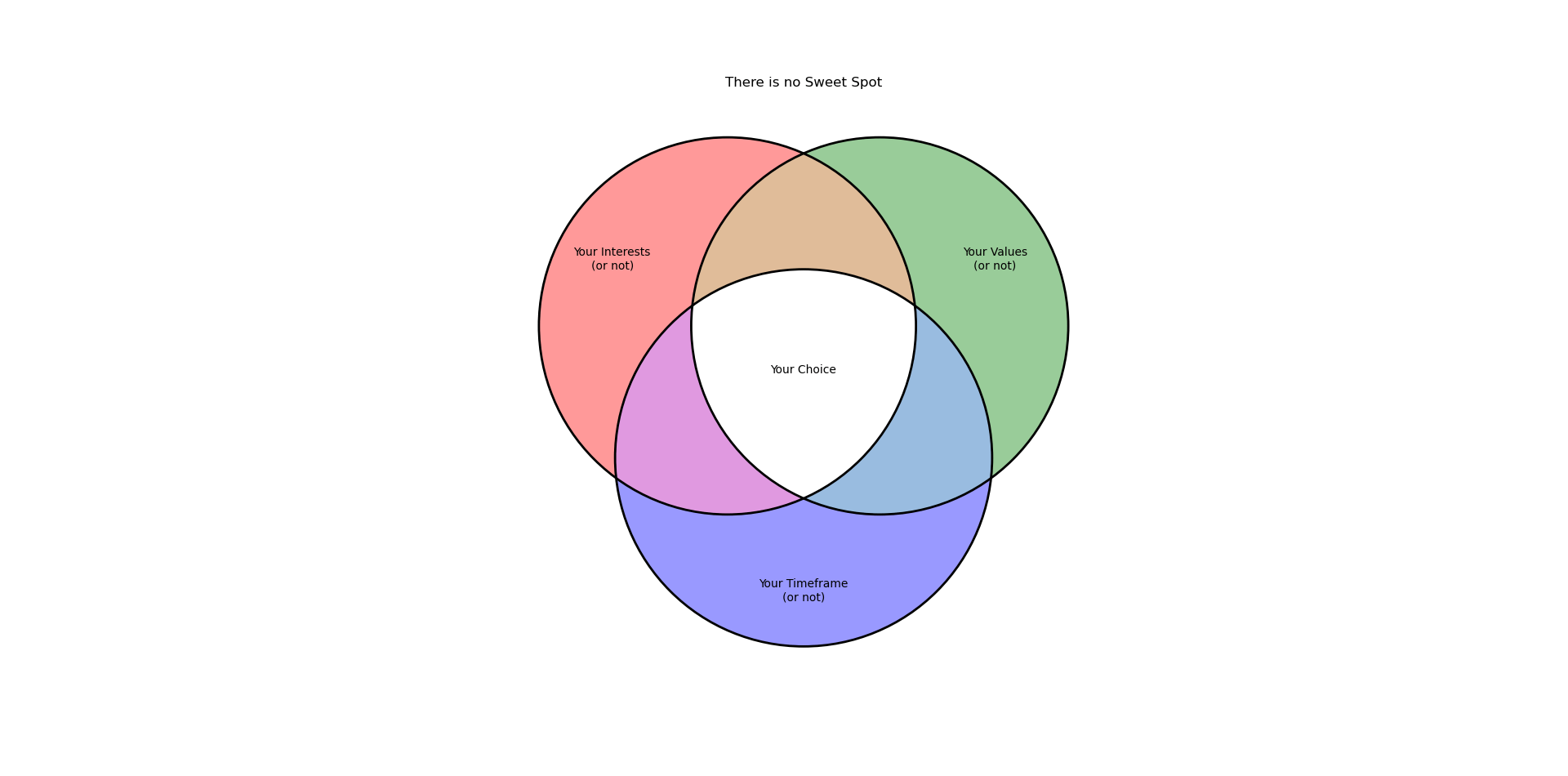
Everyone makes fun of “kids these days” for only wanting job roles that spark joy. They have the right idea but apply it to the wrong end of their career. After spending a decade or more working and saving like crazy, it’s time to collect. Reexamine your assumptions, and let the joy-sparking begin.
I think this could be useful in HS courses.